
The Hidden Risk Behind Eye Drops: Why Evidence-Based Medicine Must Prevail
In India, the eyes are often seen as the window to the soul — yet ironically, many risk their vision by trusting unproven eye drops. Across the country, shelves and online platforms are filled with products that promise to “improve eyesight,” “remove spectacles,” or “cure cataract naturally.” None of these claims, however, stand on any scientific foundation.
Despite the absence of clinical evidence, these products enjoy massive popularity. It is time we confront the truth: when it comes to vision, only evidence-based allopathic medicine offers safety, reliability, and proven results.
1. No Scientific Proof, Only Marketing Claims
Allopathic medicines and eye drops undergo years of clinical trials, toxicology testing, and regulatory scrutiny before being approved for patient use. In contrast, most eye drops on the market have no published research, no randomized studies, and no data proving their benefits for vision.
The claims are purely anecdotal and often exaggerated by marketing. When it comes to eye health — where a single infection or toxic reaction can lead to blindness — guessing is not acceptable.
2. Real Harm Behind the “Natural” Label
The common misconception that “natural means safe” is dangerous. Several so-called or herbal eye drops have been found to contain non-sterile ingredients, preservatives, and even steroids or heavy metals that can harm the cornea and retina.
Cases of corneal ulcers, chemical burns, and allergic reactions are being increasingly reported due to unregulated products sold under the label.
In contrast, allopathic ophthalmic preparations are manufactured under sterile conditions, undergo strict pharmacological quality checks, and are supported by safety data.
3. Delay in Treatment Can Lead to Irreversible Blindness
Perhaps the most serious damage done by such unscientific products is delay in proper treatment. People use eye drops for conditions like cataract, glaucoma, or diabetic retinopathy — diseases that require timely medical or surgical intervention.
By the time they consult an ophthalmologist, the disease is often advanced and irreversible. What could have been corrected with a simple surgery or medication may then lead to permanent vision loss.
4. Evidence-Based Medicine Is Built on Science, Not Belief
Allopathic eye care is not based on faith — it is based on data, observation, and reproducible results. Each drug or procedure, from cataract surgery to anti-VEGF injections, is backed by scientific studies and international standards.
eye drops, in contrast, rely on traditional belief rather than biological evidence. Medicine must evolve with knowledge — not tradition alone.
5. The Role of Ophthalmologists and Public Awareness
It is the duty of eye specialists, healthcare institutions, and NGOs to educate the public about the dangers of untested remedies. Patients must be encouraged to seek professional eye check-ups rather than over-the-counter “natural cures.”
Public health messages should clearly convey that scientific medicine saves sight — while unproven therapies often waste precious time and vision.
Conclusion
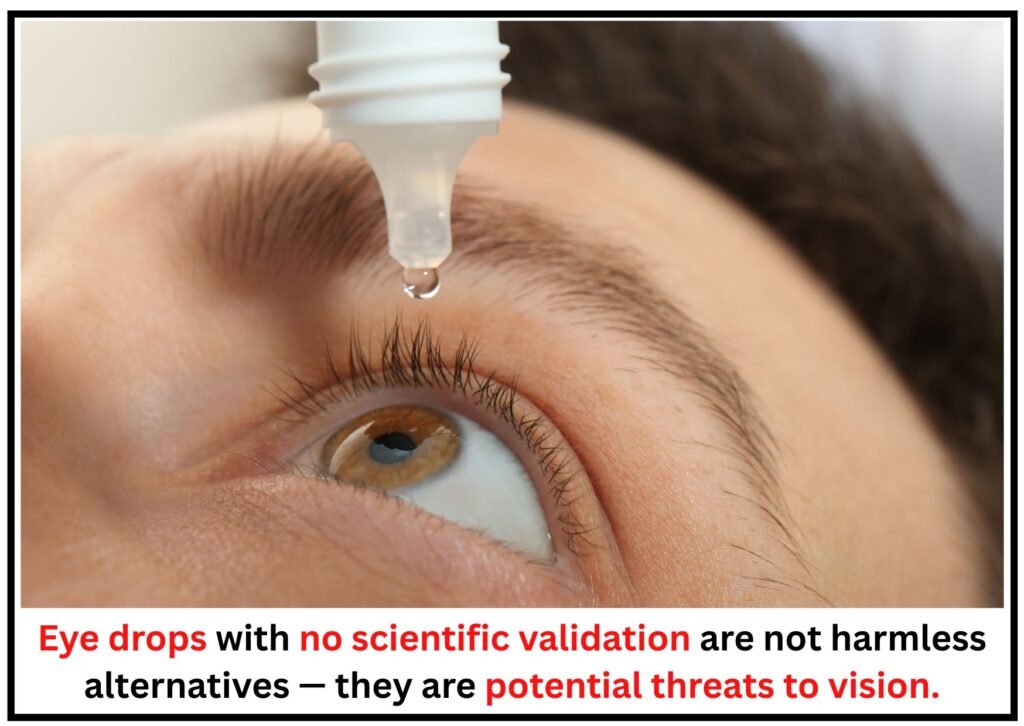
When it comes to the eyes, there is no room for experiment or blind faith. eye drops with no scientific validation are not harmless alternatives — they are potential threats to vision.
India needs stronger regulation, greater public awareness, and a firm commitment to evidence-based, allopathic eye care. The eyes deserve nothing less than the safety and certainty that science provides.